150+ Earth Science Topics for Students and Researchers (With Examples)


Explore 150+ Earth Science topics for students and researchers. Covers geology, astronomy, climate, and grade 7 topics with ready-made presentations.
Earth is the only planet we know that sustains life, yet we are still discovering how it works. From earthquakes that shake entire continents to climate change that reshapes our future, Earth Science gives us the knowledge to understand, predict, and protect our planet.
For students, Earth Science topics make for exciting projects, research papers, and presentations. For researchers, they open doors to solving global challenges like sustainability, resource management, and disaster preparedness. And for curious learners, they answer fundamental questions about our place in the universe.
In this blog, we’ll explore 150+ Earth Science topics covering everything from geology and climate change to astronomy and oceanography. Whether you’re searching for earth and space science topics, earth science research topics, or even earth science topics for grade 7, you’ll find detailed examples with ready-to-use presentation links.
What is Earth Science?
Earth Science is the study of the Earth, its structure, processes, history, and relationship with the universe. It combines multiple disciplines:
- Geology – rocks, minerals, plate tectonics, earthquakes, and volcanoes.
- Meteorology – weather, atmosphere, and climate.
- Oceanography – oceans, waves, tides, and marine ecosystems.
- Astronomy – planets, stars, and space science.
- Environmental Science – sustainability, conservation, and human impacts.
Simply put, Earth Science answers: How does our planet work, and how do we protect it?
Why Study Earth Science?
Studying Earth Science matters because it helps us:
- Understand Natural Hazards – predicting earthquakes, tsunamis, and hurricanes.
- Combat Climate Change – studying global warming and carbon cycles.
- Manage Resources – finding clean water, energy, and minerals.
- Protect Ecosystems – conserving biodiversity and marine life.
- Explore Space – linking Earth processes with planetary science.
From grade 7 students learning about rocks and weather to PhD researchers tackling carbon capture, Earth Science is relevant for every learner.
Top 150+ Earth Science Topics for Projects, Research Papers & PPTs
| Topic | Brief Description | Create Presentation |
| Climate Change and Human Impact | Study how humans affect the Earth’s climate. | Create |
| Plate Tectonics | How shifting plates shape Earth’s surface. | Create |
| Earthquakes | Causes, effects, and measurement methods. | Create |
| Volcanoes | Study of eruptions and their environmental effects. | Create |
| Rock Cycle | How rocks transform between igneous, sedimentary, and metamorphic. | Create |
| Soil Formation | How soil develops from weathering and organic matter. | Create |
| Erosion and Weathering | Forces that wear down and reshape landscapes. | Create |
| Fossils and Paleontology | What fossils teach us about Earth’s history. | Create |
| Geologic Time Scale | History of Earth from Precambrian to present. | Create |
| Natural Disasters | Overview of earthquakes, floods, and cyclones. | Create |
Earth & Space Science Topics for Research Papers & PPTs
| Topic | Brief Description | Create Presentation |
| Solar System | Study of planets, moons, and the Sun. | Create |
| The Moon and Tides | How lunar gravity shapes ocean tides. | Create |
| Space Weather | Solar flares and their effects on Earth. | Create |
| Asteroids and Meteors | Rocks from space and their impacts. | Create |
| Earth’s Magnetosphere | Protects Earth from solar radiation. | Create |
| Exoplanets | Discovering planets outside our solar system. | Create |
| Big Bang Theory | Origin of the universe explained. | Create |
| Black Holes | Study of extreme space phenomena. | Create |
| Space Exploration | From Apollo missions to Mars rovers. | Create |
| Earth-Sun Relationship | How sunlight drives seasons and weather. | Create |
Earth Science Topics Related to Environmental & Climate
| Topic | Brief Description | Create Presentation |
| Global Warming | Causes and effects on ecosystems. | Create |
| Greenhouse Effect | How gases trap heat in the atmosphere. | Create |
| Air Pollution | Sources and health effects. | Create |
| Renewable Energy | Solar, wind, and hydro alternatives. | Create |
| Deforestation | Impact on biodiversity and climate. | Create |
| Water Pollution | Causes, consequences, and solutions. | Create |
| Climate Modeling | Predicting future climate changes. | Create |
| Ocean Acidification | CO₂ impact on marine life. | Create |
| Carbon Cycle | How carbon moves through Earth’s systems. | Create |
| Sustainable Development | Balancing growth with the environment. | Create |
Earth Science Topics Related to Geology & Earth Surface
| Topic | Brief Description | Create Presentation |
|---|---|---|
| Minerals and Crystals | Properties and classification of minerals. | Create |
| Types of Rocks | Igneous, sedimentary, and metamorphic rocks. | Create |
| Earth’s Layers | Crust, mantle, outer, and inner core. | Create |
| Plate Boundaries | Divergent, convergent, and transform faults. | Create |
| Earthquake Waves | P-waves, S-waves, and surface waves. | Create |
| Volcano Types | Shield, cinder cone, and composite volcanoes. | Create |
| Mountain Building | How tectonics form mountain ranges. | Create |
| Earth’s Magnetic Field | How Earth’s core generates magnetism. | Create |
| Landslides | Causes and prevention methods. | Create |
| Geothermal Energy | Energy from Earth’s heat. | Create |
Oceanography Earth Topics for Research Papers & PPTs
| Topic | Brief Description | Create Presentation |
|---|---|---|
| Ocean Currents | Movements like Gulf Stream shaping climate. | Create |
| Waves and Tides | Physics of ocean waves and tidal cycles. | Create |
| Coral Reefs | Biodiversity hotspots in shallow waters. | Create |
| Marine Ecosystems | Ocean food webs and species. | Create |
| Deep Sea Exploration | Submersibles exploring ocean trenches. | Create |
| Tsunamis | Ocean waves caused by earthquakes. | Create |
| Ocean Pollution | Plastic, oil spills, and microplastics. | Create |
| El Niño and La Niña | Climate patterns in the Pacific Ocean. | Create |
| Sea Level Rise | Impact of melting glaciers. | Create |
| Ocean Floor Mapping | Bathymetry and seafloor features. | Create |
Astronomy & Space Topics for Projects & PPTs
| Topic | Brief Description | Create Presentation |
|---|---|---|
| Stars and Galaxies | How stars form and galaxies evolve. | Create |
| Life Cycle of a Star | From nebula to supernova. | Create |
| The Milky Way | Our galaxy’s structure and mysteries. | Create |
| Comets | Icy visitors from outer space. | Create |
| Space Telescopes | Hubble, James Webb, and beyond. | Create |
| Gravity and Orbits | Laws governing planetary motion. | Create |
| Space Colonization | The possibility of human life on Mars. | Create |
| Dark Matter & Dark Energy | The universe’s biggest mysteries. | Create |
| Space-Time | Einstein’s relativity explained. | Create |
| Satellites | Artificial satellites and their uses. | Create |
Earth Science Research Topics for Projects, Research Papers & PPTs
| Topic | Brief Description | Create Presentation |
|---|---|---|
| Climate Modeling | Predicting Earth’s climate future. | Create |
| Renewable Resources | Researching sustainable energy. | Create |
| Ice Core Studies | Reconstructing past climates. | Create |
| Remote Sensing | Using satellites for Earth observation. | Create |
| Seismology | Advanced earthquake research. | Create |
| Carbon Capture | Technologies to reduce CO₂. | Create |
| Space Weather Impact | How solar storms affect technology. | Create |
| Paleoclimatology | Ancient climates from fossils. | Create |
| Biodiversity Loss | Causes and global patterns. | Create |
| Disaster Management | Science-based disaster reduction. | Create |
Earth Science Topics for Grade 7 Students
| Topic | Brief Description | Create Presentation |
|---|---|---|
| Water Cycle | How water moves through Earth. | Create |
| Weather vs. Climate | Key differences explained. | Create |
| Renewable vs. Nonrenewable Resources | Examples and differences. | Create |
| Earth’s Rotation and Revolution | Why do we have day, night, and seasons? | Create |
| Layers of the Atmosphere | Troposphere to exosphere. | Create |
| Simple Machines in Nature | Levers and forces in Earth processes. | Create |
| Earth’s Natural Resources | Soil, air, water, and minerals. | Create |
| Natural Disasters (Basic) | Easy presentation topics for students. | Create |
| Solar Energy | Importance of the Sun’s power. | Create |
| Rocks and Minerals (Intro) | Basic identification for kids. | Create |
Generate Earth Science Presentation with AI
Instead of spending hours making slides, you can instantly generate a full presentation with MagicSlides AI Presentation Generator. Just pick a topic above and proceed.

Making a PPT from these Earth Science topics takes only a few clicks.
Step-by-Step Way to Create a Presentation Related to Earth Science Topics:
Step 1. Click “Create” next to any topic in the tables above.
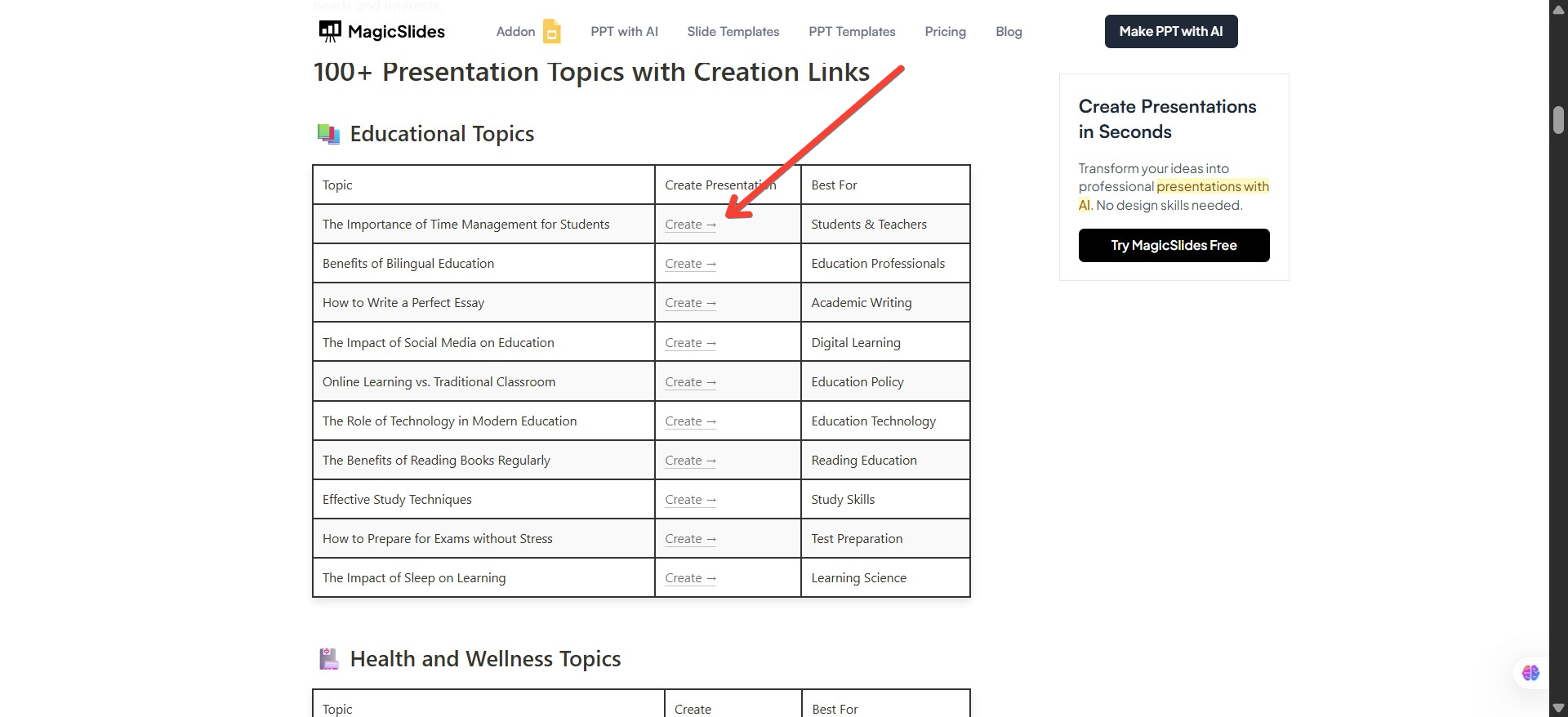
Step 2. You’ll be redirected to MagicSlides.app, where the topic will already be pre-filled for you.

Step 3. Provide your preferred settings (e.g., number of slides, design theme, and language). Choose a template that fits your style (professional, educational, creative, etc.).

Step 4. Proceed with your inputs, and within seconds, your full presentation will be ready.
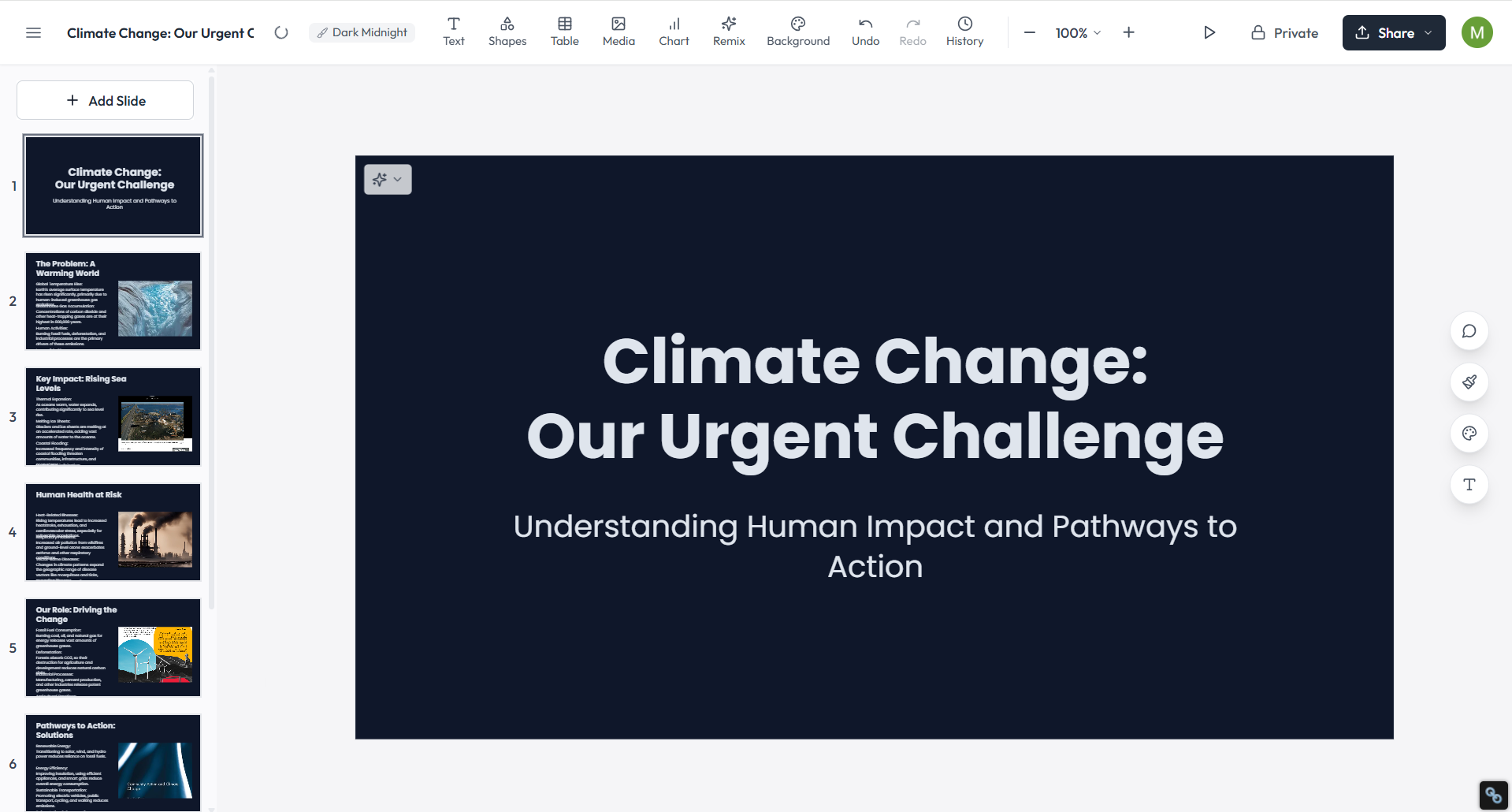
This means you can skip hours of manual work whether you’re a grade 7 student, a college researcher, or a teacher preparing lessons.
Also read: Best Public Speaking Topics Ideas for Students
Conclusion
From climate change to space exploration, Earth Science provides answers to some of the most pressing questions of our time. For students, these topics build scientific curiosity; for researchers, they help solve global challenges.
And here’s the best part: you don’t have to struggle making PPTs on these 150+ Earth Science topics. With MagicSlides templates, you can create a professional presentation in seconds. Click “Create” next to your chosen topic and get started.
FAQs on Earth Science Topics
Q1. What are Earth Science topics?
Earth Science topics are subjects that study Earth’s systems, including geology, meteorology, oceanography, astronomy, and environmental science.
Q2. What topics are covered in Earth Science?
Earth Science covers rocks, minerals, weather, climate, oceans, natural disasters, and space science, making it a broad field for students and researchers.
Q3. What are the best Earth Science research topics?
Some of the best research topics include climate modeling, ice core studies, renewable energy, carbon capture, and seismology.
Q4. What Earth Science topics are taught in Grade 7?
Grade 7 students usually learn about the water cycle, weather vs. climate, natural resources, Earth’s layers, atmosphere, and basic astronomy.


