How to Write a Business Report: Step-by-Step Guide


Learn how to write a business report with a step-by-step guide, report format, examples, templates, and AI-powered tips using Magic Docs.
Whether you’re presenting research findings, proposing a solution, or evaluating business performance, knowing how to write a business report is an essential professional skill. A well-written business report helps decision-makers understand complex information, identify opportunities, and take informed action.
In this guide, you’ll learn the business report format, key components, a step-by-step writing process, common mistakes to avoid, and a practical example to help you create reports that are clear, professional, and impactful.
What Is a Business Report?
A business report is a formal document that presents information, analyzes data, and provides recommendations to help organizations make informed decisions. Unlike casual emails or memos, business reports rely on facts, evidence, and structured analysis.
Business reports are commonly used to:
- Evaluate business performance
- Present market research
- Analyze financial data
- Recommend solutions to business problems
- Document project progress
- Support strategic decision-making
The primary goal is to communicate information clearly so stakeholders can take appropriate action.
Why Are Business Reports Important?
Professional reports help businesses transform data into actionable insights.
Some key benefits include:
- Support informed decision-making
- Improve communication across teams
- Document important findings
- Identify risks and opportunities
- Increase accountability
- Provide evidence for recommendations
Organizations of every size, from startups to multinational corporations, depend on business reports for planning and growth.

Business Report Structure
A professional business report typically follows this structure.
| Section | Purpose |
|---|---|
| Title Page | Report title, author, organization, and date |
| Executive Summary | Brief overview of the report |
| Table of Contents | Easy navigation |
| Introduction | Purpose and objectives |
| Methodology | Research methods used |
| Findings | Data collected |
| Analysis | Interpretation of findings |
| Recommendations | Suggested actions |
| Conclusion | Final summary |
| References | Sources cited |
| Appendix | Supporting documents |
Following a consistent business report format improves readability and professionalism.
How to Write a Business Report (Step-by-Step)
1. Define the Purpose
Before writing, identify:
- What problem does the report address?
- Who is the audience?
- What decisions will this report support?
A clear objective keeps the report focused and relevant.
2. Know Your Audience
Different audiences require different levels of detail.
For example:
- Executives prefer concise summaries.
- Managers need detailed analysis.
- Clients expect practical recommendations.
- Investors focus on financial insights.
Tailoring the report increases its effectiveness.
3. Gather Reliable Information
Collect accurate, up-to-date information from credible sources before you begin writing.
Common sources include:
- Company records
- Financial statements
- Customer surveys
- Market research
- Industry reports
- Government publications
Once you’ve gathered your research, use AI to generate your first draft with Magic Docs AI Document Writer. Simply enter your topic or prompt, and the tool will organize your information into a professional business report structure, saving time while maintaining clarity. Always review the generated content to ensure the facts, figures, and insights are accurate.
4. Organize Your Information
Arrange information logically before writing.
A common flow is:
- Problem
- Background
- Research
- Findings
- Analysis
- Recommendations
- Conclusion
Instead of creating the outline manually, use Magic Docs AI Document Writer to generate a structured outline automatically. It organizes your content into logical sections, making it easier to refine and expand your report.
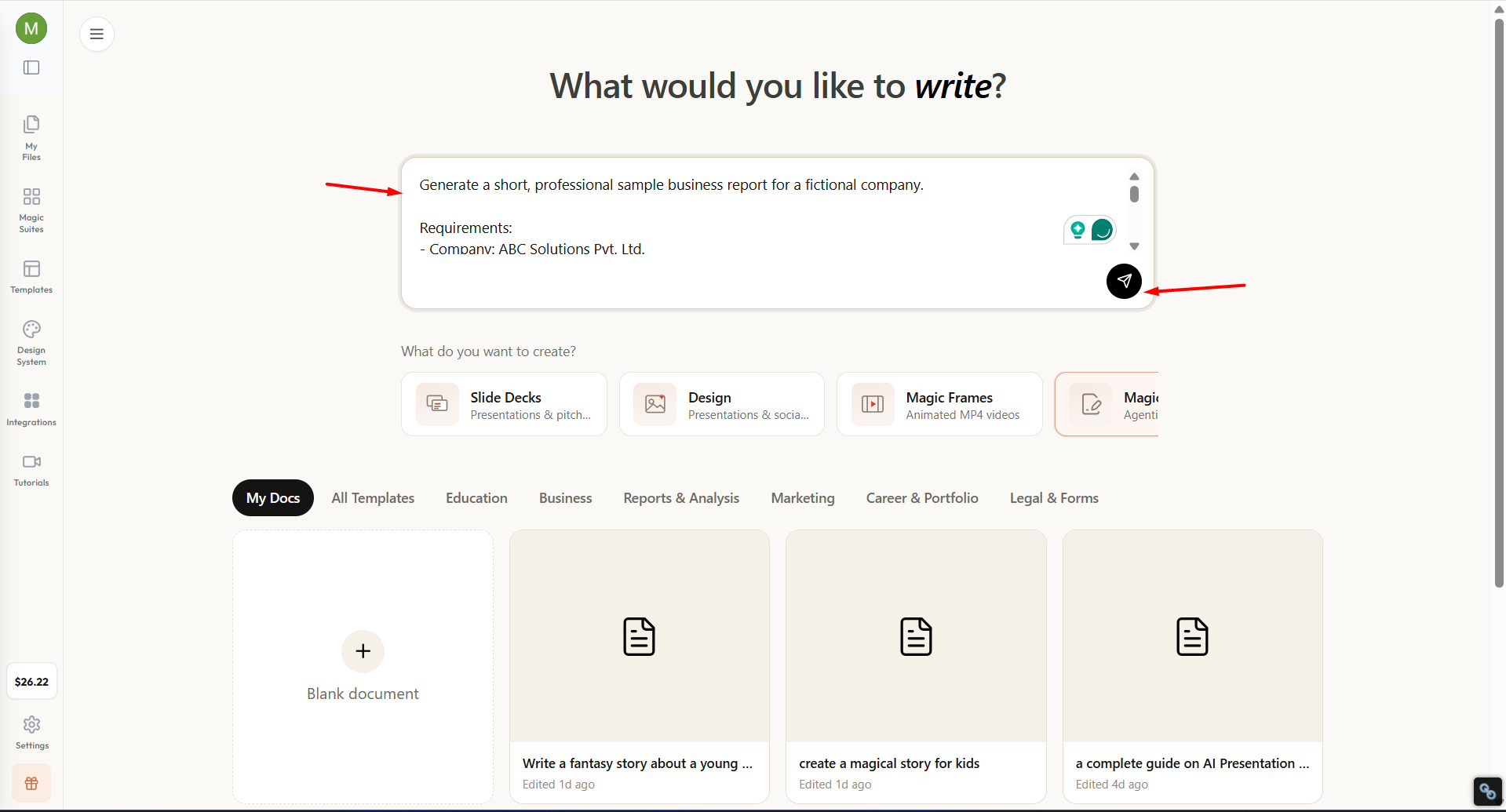
5. Write the First Draft
Start with the introduction and explain:
- Why the report was prepared
- The objectives
- The scope of the report
Then present findings using headings, tables, charts, and bullet points where appropriate.
Use AI to generate a complete first draft with Magic Docs AI Document Writer. Enter your prompt, and the tool creates a well-organized business report with standard sections like the introduction, findings, analysis, recommendations, and conclusion. You can then edit the draft, add company-specific information, and customize it for your audience instead of writing everything from scratch.
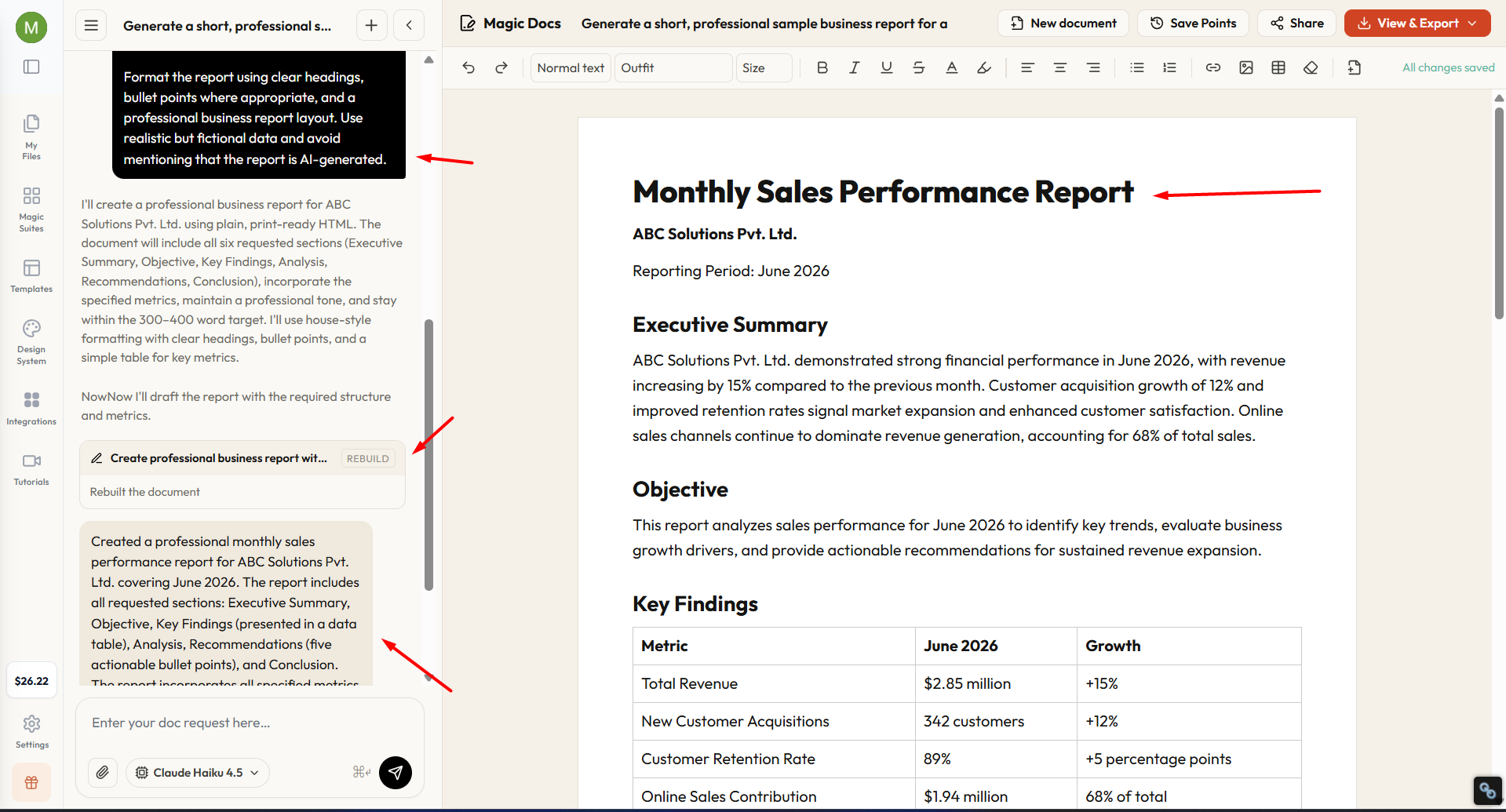
6. Analyze the Findings
Don’t simply present data; explain what it means.
For example:
Instead of writing:
Sales increased by 18%.
Write:
Sales increased by 18%, indicating stronger customer demand after launching the new marketing campaign.
Analysis helps readers understand the significance of the data.
7. Provide Practical Recommendations
Recommendations should be:
- Specific
- Realistic
- Actionable
- Supported by evidence
Example:
- Expand digital marketing campaigns.
- Improve customer onboarding.
- Reduce operational costs through automation.
- Introduce quarterly employee training.
8. Edit and Proofread
Before submitting:
- Check grammar and spelling.
- Remove unnecessary repetition.
- Verify data accuracy.
- Ensure headings are consistent.
- Confirm references are correctly cited.
A polished report reflects professionalism.
Business Report Example
Title: Customer Satisfaction Analysis
Objective
Evaluate customer satisfaction during Q2 2026.
Findings
- Customer satisfaction increased from 82% to 89%.
- Average response time decreased by 25%.
- Repeat purchases increased by 15%.
Analysis
Improved customer service response times contributed significantly to higher satisfaction levels and stronger customer retention.
- Recommendations
- Continue staff training.
- Expand live chat support.
- Monitor customer feedback monthly.
Conclusion
Investing in customer support has positively impacted customer satisfaction and business performance.
Common Mistakes to Avoid
Many reports lose credibility because of avoidable mistakes.
Avoid:
- Writing without a clear objective
- Including unnecessary information
- Using unsupported claims
- Ignoring the target audience
- Poor formatting
- Weak recommendations
- Grammar and spelling errors
A concise, evidence-based report is always more effective than a lengthy document filled with irrelevant details.
Tips for Writing Better Business Reports
To create professional reports:
- Write in a formal tone.
- Use clear headings.
- Keep sentences concise.
- Support claims with data.
- Include visuals when necessary.
- Use bullet points for readability.
- Focus on actionable recommendations.
- Proofread before submission.
These practices improve readability and help decision-makers quickly understand your findings.
Conclusion
Knowing how to write a business report is a valuable skill for students, managers, entrepreneurs, and professionals. A well-structured report combines reliable data, thoughtful analysis, and practical recommendations to support better decision-making.
By following the steps outlined in this guide, from defining your objective and gathering evidence to organizing findings and proofreading your final draft, you can create reports that are professional, persuasive, and easy to understand.
Frequently Asked Questions
What is a business report?
A business report is a structured document that presents information, analyzes data, and provides recommendations to support business decisions.
What is the standard business report format?
A typical business report includes a title page, executive summary, introduction, methodology, findings, analysis, recommendations, conclusion, references, and appendices.
How long should a business report be?
The length depends on its purpose. Internal reports may be 2–5 pages, while detailed research or strategic reports can exceed 20 pages.
What makes a good business report?
A good business report is clear, objective, evidence-based, well-structured, and focused on actionable recommendations.
What’s the difference between a business report and a business proposal?
A business report analyzes information and presents findings, while a business proposal aims to persuade stakeholders to approve a project, investment, or solution.
Also read: How to Use AI to Write a Story: A Beginner’s Guide?


