Best 5 minute Presentation topics on AI – MagicSlides.app


AI in offices streamlines tasks, boosts productivity, and offers personalized assistance, transforming the modern workplace.
AI in Education:
Artificial Intelligence is reshaping the landscape of education in remarkable ways. Through personalized learning, AI adapts content and pace to individual student needs, enhancing comprehension and engagement. Intelligent tutoring systems provide instant feedback and support, improving learning outcomes. Additionally, AI automates administrative tasks, reducing the burden on educators.

credit: freepik
AI-driven analytics offer insights into student performance, allowing educators to intervene early and provide targeted support. Virtual classrooms powered by AI facilitate global collaboration and accessible education. However, ethical concerns related to data privacy and algorithmic bias must be addressed.
AI in Autonomous Vehicles:
Autonomous vehicles represent a revolutionary application of artificial intelligence in transportation. AI-powered sensors, cameras, and machine learning algorithms enable self-driving cars to perceive and navigate their environment. This technology promises safer roads, reduced traffic congestion, and increased accessibility, particularly for those with limited mobility.
credit: freepik

However, challenges persist, including the need to refine AI algorithms for complex and unpredictable traffic scenarios. Ethical questions about the decision-making processes of autonomous vehicles in life-threatening situations are being actively debated.
Ethical Considerations in AI:
As AI technology advances, ethical considerations become increasingly crucial. AI can perpetuate bias present in training data, affecting decisions in areas like hiring, lending, and law enforcement. Ensuring fairness and transparency in AI algorithms is essential.
AI also raises privacy concerns. The collection and use of vast amounts of personal data for training AI models must be done responsibly, with robust privacy protections in place.
Furthermore, the potential for AI to replace jobs raises important economic and societal questions. Ensuring a just transition for workers affected by automation is a priority.
Ultimately, establishing clear ethical guidelines and governance frameworks is imperative to harness AI's benefits while mitigating its risks.
AI and the Job Market:
AI is reshaping the job market in profound ways. Automation of routine tasks can increase productivity but may also lead to job displacement. New roles are emerging in AI development, data analysis, and cybersecurity, requiring a workforce with updated skills.
credit: freepik

Reskilling and upskilling are essential to adapt to the changing job landscape. Lifelong learning and flexible education systems are becoming increasingly important.
AI can also improve job matching and reduce bias in recruitment processes, enhancing opportunities for job seekers. However, ethical considerations surrounding data privacy and algorithmic fairness in hiring processes must be addressed.
Navigating this transformation requires a collaborative effort among governments, businesses, and educational institutions to ensure a workforce that is well-prepared for the AI-driven future.
AI in Agriculture:
AI is revolutionizing agriculture, addressing challenges such as food security and sustainability. Through precision farming, AI technologies enable farmers to optimize resource allocation, reduce waste, and increase yields.
AI-powered drones and sensors monitor crop health, detect diseases, and optimize irrigation, leading to more efficient and eco-friendly agriculture. Machine learning models predict crop yields and provide insights for better decision-making.
credit: freepik
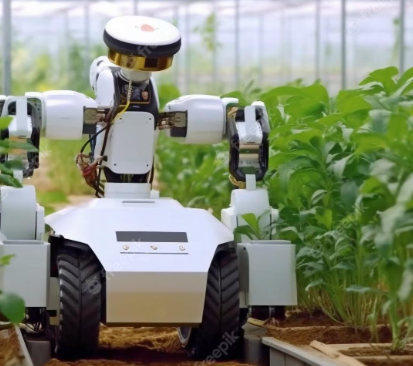
Additionally, AI enhances livestock management by monitoring animal health and automating feeding processes.
However, the adoption of AI in agriculture may face barriers such as the cost of technology and the need for digital literacy among farmers. Ensuring equitable access to AI-driven agricultural tools is crucial for global food security.
In conclusion, AI in agriculture promises to transform the industry, making it more sustainable and efficient while addressing pressing global food challenges.


